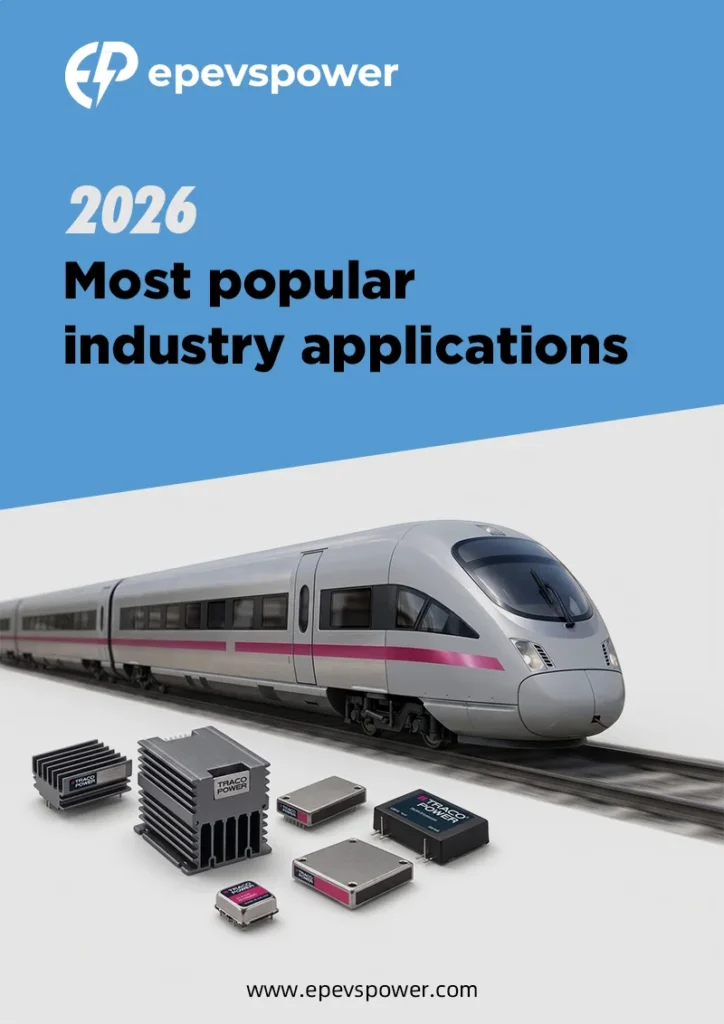
In the global pursuit of green and high-efficiency transportation, High-Speed Rail (HSR) has become a crown jewel of modern industry. However, the stability of a train traveling at 350 km/h or faster relies on more than just aerodynamic design; it depends on the complex power distribution systems within. Among these, the DC-DC converter plays a central role in regulating energy flow.
1. The “Power Hub” of HSR Systems
HSR power is typically drawn from overhead catenary lines (usually high-voltage AC), which is transformed and rectified into a DC link. Within this architecture, DC-DC converters are vital for:
- Auxiliary Power Systems (APS): Converting high-voltage DC into stable low-voltage DC to power cabin lighting, air conditioning, passenger outlets, and onboard Wi-Fi.
- Control and Safety Systems: Providing redundant and ultra-stable power for Train Control Networks (TCN), signaling systems, and emergency braking units to ensure core functionality during grid fluctuations.
- Energy Storage Management: In modern trains equipped with supercapacitors or battery packs, bidirectional DC-DC converters manage energy recovery (regenerative braking) and release.
2. Challenges in Extreme Environments
Compared to the automotive industry, HSR requirements for DC-DC converters are significantly more stringent:
- Extreme Reliability: With a design life of 20–30 years, converters must operate under high vibration and frequent acceleration/deceleration cycles.
- Wide Input Voltage Ranges: Catenary voltage fluctuates significantly; converters must possess exceptional regulation capabilities.
- Lightweight and Modular Design: To improve energy efficiency, components must be compact and light while allowing for rapid maintenance or replacement.
3. Insights from Flex: Strategic Outsourcing in Rail Equipment Manufacturing
Reflecting on the strategic benefits of outsourcing identified by Flex, HSR OEMs (Original Equipment Manufacturers) are shifting their R&D and manufacturing trends:
- Accelerated Technology Integration: The rail sector is rapidly adopting Silicon Carbide (SiC) and other advanced power semiconductors. By partnering with providers who have global supply chain reach, OEMs can access these cutting-edge components earlier, avoiding the time-sink of internal R&D and shortening delivery cycles for next-generation trains.
- Navigating Complex Compliance: Rail transport follows rigorous standards (such as EN 50155). Professional partners with established quality management systems ensure that DC-DC converters meet the highest safety and Electromagnetic Compatibility (EMC) standards during mass production.
- Optimizing Lifecycle Costs: HSR systems require spare parts support for decades. Choosing a partner with robust lifecycle management capabilities mitigates the risk of component obsolescence, ensuring hardware support throughout the train’s entire service life.
4. Conclusion
While the DC-DC converter may be a small component in the grand scale of a train, it is a cornerstone of intelligent, low-carbon high-speed rail. As rail systems move toward higher voltages and power densities, leveraging strategic outsourcing to build a more resilient manufacturing ecosystem will be the key for companies to maintain a lead in the competitive global market.